



Vietnam Wedding Ceremony
Depending on habits of specific ethnic groups, marriage includes various
steps and related procedures, but generally there are two main ceremonies:
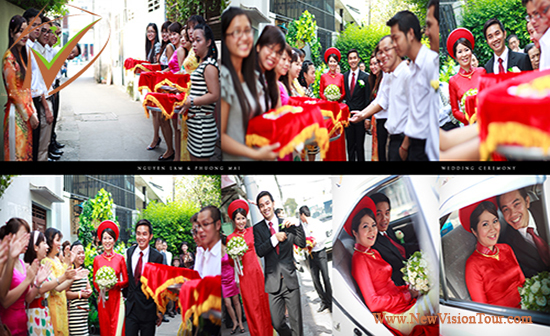
Le An Hoi (betrothal ceremony): Some time before the wedding, the groom
and his family visit the bride and her family with round lacquered boxes known
as betrothal presents composed of gifts of areca nuts and betel leaves, tea,
cake, fruits, wines and other delicacies covered with red cloth and carried by
unmarried girls or boys. Both families agree to pick a good day for wedding.
Le Cuoi (wedding ceremony): Guests would be invited to come to join a
party and celebrate the couple’s happiness. The couple should pray before the
altar asking their ancestors for permission for their marriage, then to express
their gratitude to both groom’s and bride’s parents for raising and protecting
them. Guests will share their joy at a party later.
On the wedding day, the groom's family and relatives go to the bride's
house bringing a lot of gifts wrapped in red papers. These gifts are similar to
those of the engagement: betel leaves and areca nuts, wines, fruits, cakes, tea...
Those who hold these trays are also carefully chosen; usually they are happily
married couples. Ladies and women are all dressed in Ao Dai. Men could be in
their suits or men traditional Ao Dai. The troop is usually led by a couple
that is most wealthy and successful among the relatives, this means to wish the
to-be-wed couples a blessing life together in the future.
The groom's family would stop in the front of the bride's house. The
leading couple should enter the house first bringing a tray with wine and tiny
cups on it. They would invite the bride's parents to take a sip. By accepting
the toast, the bride's family agrees for the groom family to enter their house.
The firework is immediately fired to greet the groom's family.
The groom's family would introduce themselves and ask permission for
their son to marry his bride. The Master of the Ceremony (usually a respected
person among the bride's relatives) instructs the bride's parents to present
their daughter. The bride then follows her parents out. She is in Vietnamese
traditional wedding Ao Dai which is usually in red. Followed are her bride
maids. The wedding ceremony starts in front of the altar. The bride and
the groom would kneel down and pray, asking their ancestors' permission to be
married, also asking for blessing on their family-to-be. The couple then turns
around and bow down to the bride's parents to say thank for raising and
protecting her since birth. They then bow their head to each other, which means
to show their gratitude and respect toward their soon-to-be husband or wife.
The Master of the Ceremony would gave the wedding couple advices on starting a
new family. The groom and the bride's parents would take turn to share their
experience and give blessing. The groom and the bride then exchange their
wedding rings. The parents will give the newly wedded value gifts such as
golden bracelets, ear rings, necklace... The ceremony is ended with a round
applause.
Today, a lot of Vietnamese couples have their wedding ceremony done in
Temples or Churches which is very much similar to American and Western style,
including exchanging vows and wedding rings. However, they still maintain
Vietnamese traditional ceremony in the bride's home before heading to temples
or churches.
A wedding banquet is scheduled in the evening at a hotel or a big
restaurant. It is always a delight feast that all relatives, friends, and
neighbors are invited. A music band is usually hired to play live songs.
At the banquet, the groom, bride, and their family are once again
introduced to the guests and everyone will drink a toast. Dinner will be served
at the tables.
During the reception, the groom, bride, and their parents will stop by
each table to say thank to their guests. The guest in return, will give
envelopes containing wedding cards and money gifts to the newly wedded couples
along with their blessing. A lot of weddings nowadays are followed by a dancing
party, which is opened by the groom and the bride's first dance. The party does
not recess until very late at night. The newly wedded couples then leave for
their honey moon.
