




Funeral ceremony
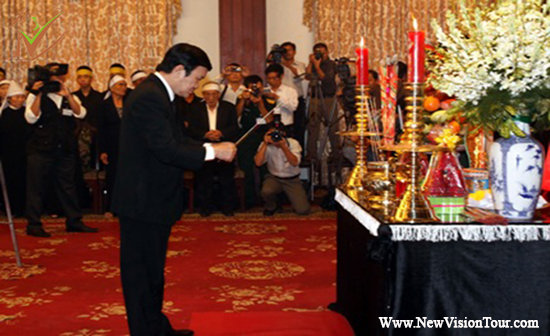
Then the body was put on a grass mat laid on the ground according to the
saying “being born from the earth, one must return back to the earth.” The dead
body was enveloped with white cloth, le kham liem, and put into the coffin, le
nhap quan. Finally, the funeral ceremony, le thanh phuc, was officially
performed.
The deceased person’s sons, daughters, and daughters-in-law had to wear
coarse gauze turbans and tunics, and hats made of straw or of dry banana fiber.
The deceased person’s grandchildren and relatives also had to wear mourning
turbans. During the days when the dead were still laid out at home, the
mourning went on with worshipping meals and mourning music. Relatives, neighbors,
and friends came to offer their condolences.
The date and time for the funeral procession, le dua tang, must be
carefully selected. Relatives, friends, and descendants take part in the
funeral procession to accompany the dead along the way to the burial ground.
Votive papers were dropped along the way. At the grave site, the coffin is buried
and covered. After three days of mourning, the family visits the tomb again, le
mo cua ma or worship the opening the grave; after 49 days, le chung that, the
family stops bringing rice for the dead to the altar. And finally, after 100
days, the family celebrates tot khoc, or the end of the tears. After one year
is the ceremony of the first anniversary of the relative’s death and after two
years is the ceremony of the end of mourning.
Nowadays, mourning ceremonies follow new rituals which are simplified;
they consist of covering and putting the dead body into the coffin, the funeral
procession, the burial of the coffin into the grave, and the visits to the
tomb. The deceased person’s family members wear a white turban or a black
mourning band.
