




Match makers in Vietnam
In the past, the weddings of Kinh people - Vietnam's ethnic majority
- were arranged by matchmakers. Before marriage, the betrothed were not allowed
to touch each other. If the young woman wished to offer her suitor a quid of
betel, she placed the quid on a tray. Feudal ethics forbade any direct
expression of love.
If the newlyweds were happy, the matchmaker became their benefactor and
was thanked with a bowl of steamed sticky rice, a boiled chicken, and a silk
dress following the wedding. When the couple celebrated the one-month
anniversary of their first child, the matchmaker was invited to the party.
Following an introduction by the matchmaker, the groom’s family would
visit the bride's family to ask after their daughter's name and age. This
ceremony was an important first step, as the girl's age determined in her
suitability as a bride. The groom's family would study the horoscopes of the
prospective couple, only agreeing to a wedding if the pair's horoscopes were
complementary. As well as having suitable horoscopes, the couple should come
from the same social class.
Asking for wedding presents was a feudal custom that placed a lot of
strain on both families. Some couples had to break up because the girl's family
demanded gifts beyond the groom’s family's means. The bride’s family might
request dresses, bottles of wine, cakes, betel nuts, rice, pigs, chickens,
jewelry, and money. Sometimes, the groom's family would go deep into debt,
forcing the young couple to spend years paying back the costs incurred by their
wedding. Resentment between the bride and groom and their respective families
was inevitable.
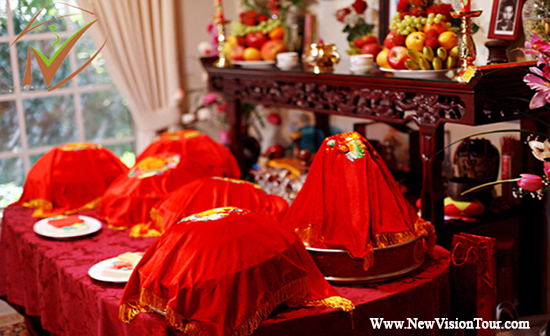
A traditional wedding ceremony involved a great many gifts. Phu the cakes
were mandatory. Made of rice flour, sugar, coconut and green beans, these cakes
consist of a round filling between two square layers - said to represent the
earth and the sky. The cakes are associated with loyalty, flexibility and
honesty.
To raise pigs you must collect ater ferns. To get married you must be pay
"way ahead" to the village.
"Way ahead" was a sum of money that the groom’s family offered
to the girl's home village. If the boy and the girl were natives of the same
village, the groom's family still had to pay "way ahead", although
the sum was smaller. Only after receiving the "way ahead" would the
village officials issue a marriage certificate. The collected money was to be
used for public works, like sinking a well or building a road.
An hour or two before it was time to fetch the bride, the groom's uncle
or aunt would go to the bride’s house to discuss the correct time to pick up
the bride. This custom allowed the families to solve last-minute obstacles of
poor weather or heavy traffic.
At the bride's home, the bride and groom worshiped at the ancestral
altar, praying that the ancestors would support their future and ensure them a
happy life. After that, the bride and groom offered a tray of betel nuts and
cigarettes to thek guests, starting with the eldest and most respected guests.
Finally, the bride and groom kowtowed to the bride’s parents. The bride’s
parents reciprocated with a small gift, normally earrings or some money.
The mother-of-the-bride was not permitted to send her daughter off to the
groom’s house. It was considered the fathers right to arrange the marriage.
Often, the bride would cry as she worried about her future among strangers,
while her mother would cry at the thought of losing her child. According to
custom, the mother was forbidden from watching her daughter’s departure.
Upon arrival at the groom’s house, other customs were observed. In the
central provinces of Nghe An-Ha Tinh, the mother-in-law would welcome the bride
by placing a water scoop and a large brass pot full of water beside the front
gate. Inside the pot she would throw a few coins. The water symbolized her
blessing for the bride, while the coins showed that the new daughter-in-law had
access to private capital.
After honoring the groom's ancestors, the mother-in-law led the bride
into the wedding room. Here, a respected older man or woman with both a son and
a daughter had spread a new flowered sedge mat on the bed. This tradition was
designed to ensure that the couple would have a son and a daughter and a happy
future.
In other parts of Vietnam, the mother-in-law was not allowed to meet the
bride, but instead took a pot of lime and went to a neighbor’s house. This
custom showed that, while she was passing authority to her daughter-in-law, she
retained the lime pot, symbolic of a woman's role in managing the housework.
In the past, most newlyweds were teenagers. It was common for girls of 13
and boys of 16 to marry. Bridesmaids would often accompany the bride to the
groom's house and spend a few days teaching the bride how to become a wife and
daughter-in-law. The bridesmaids typically departed after two or four days,
when the newlyweds performed a custom known as lot mat, in which they returned
to the bride's house to visit her parents and bring them some gifts. This
tradition expressed the children's filial piety towards their parents.
Today, young people in Vietnam are free to choose their own partners. To
outsiders, weddings may appear very westernized, as most brides don white
gowns, while the groom’s family hosts a large reception, often in a restaurant
or hotel. Behind the scenes, however, many of the old traditions persist. From
the offering of betel nuts to the ceremonial laying down of the newlyweds'
sedge mat, wedding rituals have retained their symbolic value.
