



Lam Son Insurrection and the war of independence
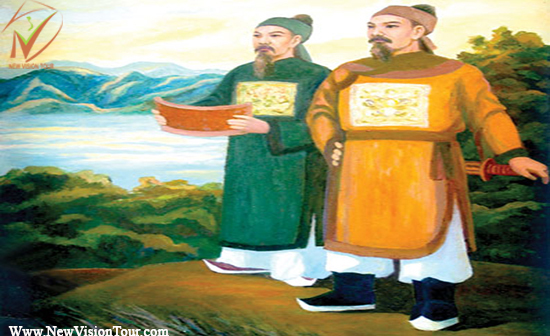
Le Loi, a land-owner from Lam Son in Thanh
Hoa Province was born in 1385. Before launching the insurrection against the
Ming, he gathered about 1000 followers around him. On February 7, 1418 in Lam
Son, he proclaimed himself king under the name Binh Dinh Vuong, and began
gathering under his banner anyone who oppose Ming domination. Nguyen Trai, a
famous scholar, became his closest adviser on strategy and politics. Working
together, the two men brought the insurrection to victory after long years of
struggle.
At first Le Loi launched guerrilla operations
in mountainous area of Thanh Hoa. Although he inflicted losses to the Ming, he
often found himself in a critical, even desperate situation. However, his
forces held out thanks to the courage of the men, the resolve of the leaders,
and the dedication of the officers. Other popular uprisings in various
provinces helped loosen Ming pressure on Le Loi. In 1420, his troops were able
to camp on the banks of the Ma River and threaten the capital of Thanh Hoa
Province. A Ming counter-attack, however, drove them back to the mountains in
1423. But the Ming troops were also worn out, and their command agreed to a
truce proposed by Le Loi, who resolutely resisted all attempts to buy him off
with promises of riches and honours. In 1424, the Ming again attacked, but the
insurgents had time to strengthen their position.
On the advice of Nguyen Chich, Le Loi
took his troops to Nghe An and turned it into a resistance base. The insurgents
were enthusiastically welcomed by the local people. Fortified enemy positions fell
one after another, and soon the whole province was in Le Loi's hands. Next came
Thanh Hoa, then provinces south of Nghe An. By the end of 1425, the whole
southern part of the country had been liberated, with the exception of the Nghe
An and Tay Do (Thanh Hoa) citadels. A vast rear base had thus been created for
the war of national liberation. In 1426, Le Loi was in a position to launch a
counter-offensive.
The Ming sent 50,000 reinforcements from
China under the command of Vuong Thong. Even before they arrived, Le Loi had
started his offensive to seize back the Red River Delta. In September 1426, he
dispatched three armies northward; one was to intercept Ming reinforcements
coming from Yunnan, the second coming through Lang Son, and the last was to
march on the capital. Everywhere the people rallied to his banner with
enthusiasm, while panic-stricken Ming troops withdrew into their citadels and
tried to hold out until the reinforcements arrived.
In November, Vuong Thong's troops joined
the Ming troops who had shut themselves up behind the walls of the capital,
bringing their strength to 100,000. They thought they were now in a position to
counter-attack, but instead they suffered a crushing defeat at Tot Dong (west
of the capital) and again had to withdraw into the citadel. The Vietnamese
troops had gained control of the area. Le Loi left Thanh Hoa and concentrated
his forces round the capital. Vuong Thong proposed a truce. In a letter to the
Ming general, Nguyen Trai said that the Vietnamese command would agree to a
truce if Vuong Thong were to withdraw his troops from the country, thus
"sparing our people the ravages of war and the Chinese troops the
sufferings of battle".
But for Vuong Thong the truce was just a
strategy to gain time and obtain more reinforcements. While maintaining the
siege and eliminating isolated outposts, the Vietnamese Command, on Nguyen
Trai's recommendation, conducted a campaign of political persuasion directed at
the Ming troops, driving home to them the inevitability of defeat, the strength
of the Vietnamese national movement and the vulnerability of the Ming Empire.
This seriously demoralized them.
In October 1427, Ming reinforcements came in two
columns: one was 100,000 strong and led by Lieu Thang through the Lang Son
pass; the other, 50,000 strong, was led by Moc Thanh via the Red River valley.
The Vietnamese command decided to destroy the more important army. Lieu Thang's
troops, overconfident about their strength, were ambushed and routed at the Chi
Lang Defile. The commander was killed and several generals captured together
with 30,000 men. The other Ming column was filled with panic on hearing of this
disaster and fled in disorder pursued by Le Loi's troops.
After the destruction of this reinforcement, Vuong
Thong who was besieged in the capital was forced to sue for peace. His request
was granted by Le Loi, who gave the Ming troops the necessary food supplies and
means of transport to get home. It was December 29, 1427.
The war of independence led by Le Loi and Nguyen
Trai had lasted ten years. Starting with few resources, the movement had
expanded, gradually establishing powerful bases and forces, and eventually
destroying huge enemy armies. The command had combined guerrilla warfare with
mobile warfare and attacks on fortified position, political struggle with
military action, and had shown kindness toward the enemy and avoided pointless
massacres. Le Loi, from the land-owning class rather than the landed
aristocracy, and Nguyen Trai, a Confucian scholar with an encyclopedic
knowledge, had succeeded in bringing about national unity and inspiring
patriotism. As well, they had shown resolve and wisdom at critical and decisive
moments. The war was both national and popular in nature and conducted with
appropriate strategy and tactics. Never again would the Ming try to reconquer
Dai Viet. The following period of peace between China and Dai Viet was to last
for over three centuries.
