




Country's official name
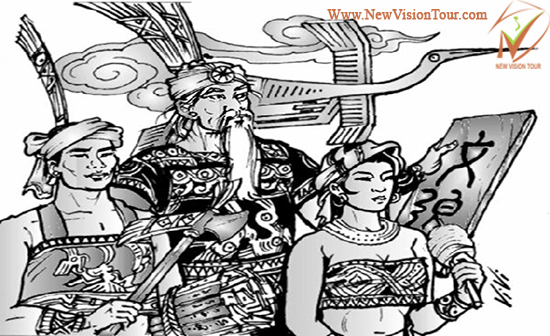
Van Lang (2876 BC – 258 BC)
At that time,
the two ethnic tribes of the Lac Viet and Au Viet lived together in many areas
with other inhabitants. Due to the increasing need to control floods, fight
against invaders, and exchange culture and economy, these tribes living near
each other tended to gather together and integrate into a larger mixed group.
Among these Lac Viet tribes was the Van Lang, which was the most powerful
tribe. The leader of this tribe joined all the Lac Viet tribes together to
found Van Lang Nation, addressing himself as King Hung. The next generations
followed in their father’s footsteps and kept this appellation. Based on
historical documents, researchers correlatively delineated the location of Van
Lang Nation to the present day regions of North and north of Central Vietnam,
as well as the south of present-day Kwangsi (China). The Van Lang Nation
approximately lasted from the beginning of the first millennium B.C. to the 3rd
century B.C.
Au Lac (257 BC – 207 BC)
In 221 BC, Qin
Shihuangdi (Tan Thuy Hoang), King of Qin (China), invaded the land of the Viet
tribes. Thuc Phan, the leader of the alliance of Au-Viet tribes was respected
as the chief of the resistance war against the Tan enemy that later, in 208 BC,
was forced to withdraw. With his imposing power, Thuc Phan nominated himself as
King An Duong Vuong and founded Au Lac Nation with groups of Lac Viet and Au
Viet tribes. In 207 BC, Trieu Da, King of Nam Viet (China), invaded Au Lac
country. The resistance of An Duong Vuong failed soon after this invasion. As a
result, the northern feudalist took turns dominating the country over the next
seven centuries, establishing their harsh regime in the country and dividing
the country into administrative regions and districts with unfamiliar names.
However, the country’s name of Au Lac could not be erased from the people’s
minds in their everyday life.
Van Xuan (544 – 602)
In the spring of
542, Ly Bi rose up in arms and swept away the Chinese administration,
liberating the territory. He declared himself King of Van Xuan
Kingdom in February 544, acknowledging the national superiority complex of the
independent spirits to live in eternal peace. However, the existence of Ly Bi’s
administration was very brief. He was defeated by the Chinese imperial army,
and the country returned to feudal Chinese domination again in 602. The name
Van Xuan was restored only after the victory over the Han army at the Bach Dang
River led by General Ngo Quyen in 938. This victory marked the end of the
Chinese domination period in Vietnam.
Dai Co Viet (968 – 1054)
In 968, Dinh Bo
Linh defeated the twelve lords and unified the country. He declared himself
King and named the country Dai Co Viet. This name remained
throughout the Dinh Dynasty (968-980), Pre-Le Dynasty (980-1009) and the
beginning of Ly Dynasty (1010-1225).
Dai Viet (1054 – 1802)
In 1054, a
flaming bright star appeared in the sky for many days, which was considered a
good omen. As a result, the King Ly changed the name of the country to Dai
Viet. This name remained until the end of Tran Dynasty (1126 - 1400).
The name Dai Viet remained under the Le Dynasty (1428-1788) and the Tay Son
Dynasty (1788-1802).
Dai Ngu (1400 – 1406)
In March 1400,
Ho Quy Ly usurped the throne of King Tran Thieu De, founded the Ho Dynasty and
changed the country’s name to Dai Ngu, meaning peace in the
ancient language. This name only lasted for very short time, until April 1407,
when the Ming enemy invaded Dai Ngu and defeated the Ho Dynasty (1400-1407).
After 10 years
of resistance against the Ming occupation (1418-1427), Le Loi had achieved a
victorious triumph. In 1428, Le Loi declared himself King of Le Dynasty and
changed the name of the country back to Dai Viet. At this time, the territory
of Vietnam had expanded to the region of present-day Hue.
Vietnam
In 1802, Nguyen
Anh claimed his coronation to become the first King Nguyen, starting the Nguyen
dynasty and changing the country’s name to Vietnam. This name was officially
recognized in many diplomatic missions in 1804. However, the words "Viet
Nam" had already appeared very early in history. In the 14th century,
there was a book of code entitled "Viet Nam the Chi", edited by Doctor
Ho Tong Thoc. In the book by scholar Nguyen Trai entitled "Du Dia
Chi" at the beginning of 15th century; the words "Viet Nam" were
repeated several times. Doctor Trinh Nguyen Binh Khiem (1491-1585) had written
on the first page of his work "Trinh Tien Sinh Quoc Ngu" the
following: "... Viet Nam have constructed its foundation..." The
words "Viet Nam" were also found in some carved stelae of the 16th -
17th century in Bao Lam Pagoda, Haiphong (1558), in Cam Lo Pagoda, Ha Tay (1590),
in Phuc Thanh Pagoda, Bac Ninh (1664), etc. In particular, in the first
sentence on the stele Thuy Mon Dinh (1670) at the landmark on the border at
Lang Son, it was written: "This is the gateway of Viet Nam that guards the
northern frontiers..." In terms of meaning, there are many theories that
prove the words "Viet Nam" are created by combining two racial and
geographic elements, which is understood as "Viet people from the
south". During the reign of King Minh Mang (1820-1840), the name of the
country was changed to Dai Nam, but Viet Nam was still widely used in many
literary works, civil business affairs, and social relations.
Following the
triumph of the August Revolution on August 19th 1945, which had entirely swept
away Vietnamese feudal and French colonial oppression and began a new era in
the country, President Ho Chi Minh proclaimed the nation’s independence and the
national name Democratic Republic of Vietnam was born on September 2nd 1945.
Although Vietnam suffered from war and separation in the following 30 years, the
sacred words "Viet Nam" were very popularly used from the North to
the South, and were deeply imprinted in the hearts of the Vietnamese people.
Following the liberation of Southern Vietnam on April 30 1975, the entire
country of Vietnam was completely unified. In the first meeting of the National
Assembly of the Unified Vietnam on July 2nd 1976, the assembly decided to name
the country The Socialist Republic of Vietnam. The constitution of 1980, and
1992, continued its affirmation of the country’s official name, legally and
actually.
