



Insurrections and the struggle for independence
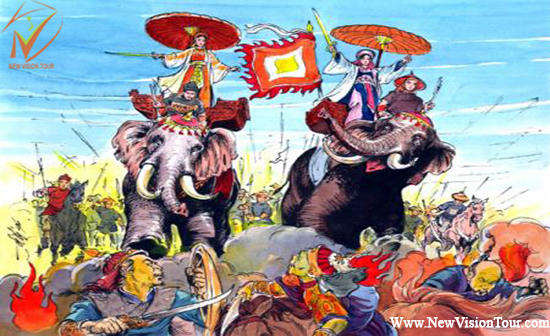
The most important was that of the two sisters,
Trung Trac and Trung Nhi, born of a family of military chiefs in the district
of Me Linh (northwest of Hanoi). Between 40 and 43 A.D the Trung sisters
launched a vast movement throughout Chiao Chih led by women in many places.
Trung Trac was made "Queen" and Chinese imperialist domination was
overthrown. The Han emperor, then at the peak of his power, had to send
his best general, Ma Yuan "Tamer of Waters"to Chiao Chih. By the end
of the year 43 A.D., the insurrection was crushed, but it left an indelible
imprint on the history of the country.
However, Chinese annals kept deploring that
"the people of Chiao Chih, relying on remote inaccessible areas, liked to
rebel". The insurrection in the Red River valley spread to the south;
military posts and the domains of imperial functionaries were attacked. Another
young woman, Lady Trieu, launched a large-scale movement against foreign
domination in 248 A.D. in the province of Chiu Chen (present-day Thanh Hoa
Province). She said, "I'd like to ride storms, kill the sharks in the open
sea, drive out the aggressors, reconquer the country, undo the tics of serfdom,
and never bend my back to be the concubine of any man". Riding an
elephant, she led the way to the battlefield. However, she was unable to maintain
a very long resistance against the Chinese Imperial army.
The
Sui dynasty moved the administrative capital to Tong Binh (present-day Hanoi).
In 618, the Tang dynasty took power in China; China's economy and culture saw
unprecedented development as the empire experienced its greatest ever
expansion. For the Tang dynasty, Chiao Chih (Vietnam) was not only a colony for
exploitation, but also a starting point for expansion into Southeast Asia. In
679, they instituted the "Protectorate of Annam (Pacified South)";
the term then came to be used for tile country itself. The Tang dynasty
extended their administrative network to cover villages and mountainous
regions; the annual tribute to the Court and the various taxes, cover and
duties were increased. However agriculture and handicrafts in particular,
continued to develop, as well as land, river and maritime communications. The
three doctrines -Confucianism, Taoism, and notably Buddhism - spread
nationwide, without doing away with local beliefs. The veneration of local
genies, often patriots or founders of villages, remained widespread. In order
to stifle deep-rooted national sentiment, the Chinese imperialists used
geomancy in an attempt to drain the "veins of the dragon" running
through Vietnamese soi resulting in resistance from the people. In society,
more and more of those obtaining high positions in the administration through
education or bribery were those who obtained important domains.
Under
the Tang dynasty the country faced several invasions from the south - Champa,
Java, and Malaya and from the kingdom of Nan Chiao (present-day Yunnan). In
863, Nan Chiao troops reached the capital Tong Binh and destroyed it. The Tang
Court had to send General Gao Pian to fight against the Nan Chiao. Becoming
governor after defeating the Nan Chiao, Gao Pian tried to suppress the
nationalist movement which had continued to develop after the Tang dynasty took
power.
Many
insurrections took place under the Tang dynasty, including that of Ly Tu Tien
and Dinh Kien in 687, of Mai Thuc Loan in 722, of Phung Hung in 766-791, and
Duong Thanh in 819-820. By the end of the 9th century, internal
disturbances, particularly the insurrection of Hwang Chao (874-883) in China,
shook the Tang reign and China entered a long period of anarchy that started at
the beginning of the 10th century. In 905, the last governor sent by the
Chinese imperial court to Vietnam died.
Taking
advantage of the disturbances in China, a notable from Cuc Bo (in the
present-day province of Hai Duong), Khuc Thua Du, made himself governor, and in
906 the Tang court had to recognize this fait accompli. Khuc Thua Du's son,
Khuc Hao, tried to set up a national administration; in 930 the Southern Ban
dynasty, which had taken power in southern China, again invaded the country. In
931, however, a patriot, Duong Dinh Nghe, took up the fight and made himself
governor. After Duong Dinh Nghe died, murdered by one of his aides, the fight
was led by Ngo Quyen, who in 938 clashed with a Southern Han expeditionary
corps approaching by sea. The Southern Han fleet entered Vietnam via the Bach
Dang estuary (mouth of the river which flows into Halong Bay) where iron-tipped
stakes had been sunk into the riverbed by Ngo Quyen. At high-tide a Vietnamese
flotilla attacked the enemy then, pretending to escape, lured the Southern Han
boats into the estuary beyond the stakes still covered by the tide. At
low-tide, the entire Vietnamese fleet counter-attacked, forcing the enemy to
flee and sink, impaled on the barrage of stakes.
The Bach Dang victory in 938 put an end to the
period of Chinese imperial domination. In 939 Ngo Quyen proclaimed himself
king, established his capital at Co Loa (previously a capital in the 3rd
century B.C.) and set up a centralized government. It was the first truly independent
Vietnamese state.
Domestically, the main obstacle to the founding of
a centralized power structure capable of assuming direction of the economy -
management of the dyke system in particular - and of successfully resisting
foreign aggression was the existence of feudal lords who each ruled an area of
territory. On the death of Ngo Quyen in 944, 12 warlords divided the country
among themselves and began to fight one another.
Starting from Hoa Lu in present-day Ninh
Binh, Dinh Bo Linh defeated them all, one after another, and unified the
country in 967. The next year he made himself king, named the country Dai Co
Viet, established his capital at Hoa Lu, reorganized the army and
administration, and appointed renowned Buddhist monks as advisers. The murder of
Dinh Bo Linh in 979 brought a six-year-old child to the throne. Meanwhile the
Sung dynasty had taken power in China where order was restored. A Sung
expeditionary corps was sent to reconquer Vietnam, which was also being
attacked from the south by the Cham. To deal with this danger, the Court and
army appointed a talented general, Le Hoan. The latter defeated the Sung army
on both land and water, thus saving the country (981). The next year, and
expedition led by Le Hoan invaded the Kingdom of Champa and
conquered its capital Indrapura (now in Quang Nam province), removing the
threat of invasion from the south for a long time to come.
