

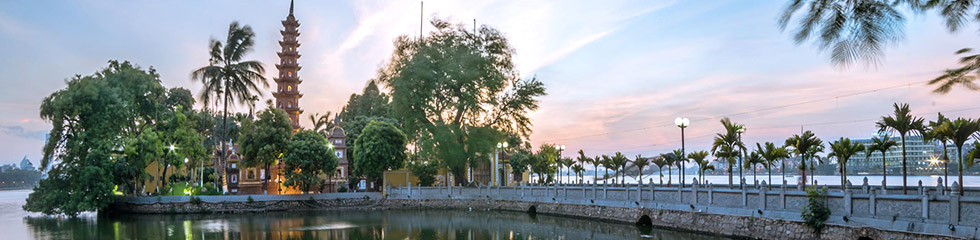


Quan Ho
Hát Quan Họ was born about the 13th century in the Bắc
Ninh province and was always heard during spring festivals, especially of the
Buddhists. Bắc Ninh is the province where numerous pagodas were built,
therefore, big Buddhist offering ceremonies were celebrated each year in
spring. Boys and girls came to adore Buddha and after that, gathered together
in front of or inside the pagoda or in the field to sing "Hát Quan Họ".
Originally Hát Quan Họ was exchange songs between
two mandarins' families. Gradually, it spread out and became popular among the
northern people. Groups were formed just for singing, and many marriages were
formed at these get-togethers. After centuries, hát quan họ became the most significant Vietnamese folk-song type.
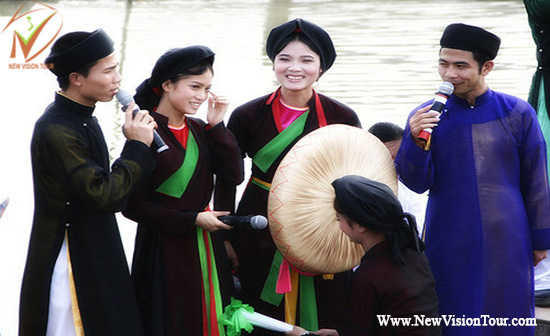
Hát Quan Họ, also called Quan Họ Bắc Ninh singing,
is an antiphonal singing tradition in which men and women take turns singing in
a challenge-and-response fashion drawing on a known repertoire of melodies.
Usually a pair of women starts, presenting in unison a complete song called câu ra (“challenge phrase”) lasting
three to eight minutes. A pair of men of the opposing team responds with
another song called câu đối
(“matching phrase”), which must match the melody of the women's song in order
to be considered correct. Next it will be the men's turn to challenge the women
with a song that can be completely different from the previous pair of songs.
According to the tradition, only young people used
to sing quan họ songs, as the major body of song texts centers on the subject
of love and sentimental desire among young adults. Nowadays, elderly singers
are quite enthusiastic about singing for guests.
Unlike the simple lullabies, which were inspired by
daily works, Hát Quan Họ was always searching for new content and new reforms.
Love in Hát Quan Họ is not sad and pessimistic as it
is in lullabies (ru) or in calls (hò). On the contrary, the tunes of this type
are rich in tunes and rhythms because it received all the influences of
lullabies, poem recitation, etc.
There are four major airs in Hát Quan Họ:
1. Giọng sổng (transitor air)
2. Giọng vặt (diverse air)
3. Giọng hãm (recitative air)
4. Giọng bỉ (tunes borrowed from other sources)
The most popular Quan Họ songs, "Qua Cầu Gío
Bay", "Trèo Lên Quán Dốc" (also known as "Lý Cây Ða"),
"Se Chỉ Luồn Kim", were sung in Giọng vặt. The singers also imitated
the musical sound, the sound of rice grinding, crying, etc. When one of the two
singing groups used any specific tune, the other one was to reply in the same
tune. The singing ends with songs in the farewell category, a feature that has
never been changed giving the singing session a sense of completion.
Hát Quan Họ was spring festival songs. The farmers
left their farming for a while to enjoy the beautiful weather, especially
during the Lunar New Year (Tết).
Hát Quan Họ in Festivals
For the Bắc Ninh people, festivals not only allow
them to highlight their own village's specialties, such as ceramics, folk
painting, wrestling, kite parades, or bird contest, among a great many other
things, but also their common prized heritage, the Hát Quan Họ tradition.
Hát Quan Họ in festivals traditionally began either
at the communal-ritual house or at the Buddhist temple as early as the night
before the main festival day. Nowadays, only a few major festivals continue
that tradition, while most villages carry out the singing on the main day.
Familiar Repertoire
Considering how extensive the quan họ repertoire appears to be, it is noticeable that songs heard
in festivals are rather limited in number and repetitive in titles. Many
singers contend that at festivals they prefer to sing songs that are familiar
or easy to listen to. Common titles sung in festivals can be divided into two
categories.
The first category includes such songs as "Em là cô gái Bắc Ninh"
("I am a girl from Bắc Ninh") which has been considered as the Quan Họ "flag song" or
signature song for some time by the younger generations, and "Ngồi tựa mạn thuyền"
("Leaning by the Boat-Side"), perhaps the most favored Quan Họ song across different
generations, in spite of generational and village variations which exist in
singing practice. These two songs speak both to the locals' perception of
regional identity and to their musical affinity to the basic features of quan họ melody.
The second category includes the majority of songs
such as "Vào Chùa"
("Entering the Buddhist Temple") and "Khách đến chơi nhà" ("Visitors Are Coming")
display a musical contour that bears a strong connection to the official
linguistic tonality of North Vietnam, on the one hand, while suggesting some
resonance of the Cantonese mode as well as what the Vietnamese music scholars
have been calling the "South" mode.
Song Text, Verbal and Poetic Introduction
Following the textual content of quan họ songs within the festival
reveals a striking contrast between the open, public setting and the intimate
characteristic of the songs. Virtually all songs heard in festivals express
personal subjects such as unfulfilled love, expectation, longing, and intimacy.
Quan Ho
songs are unique in the sense that they place men and women on an equal basis,
with mutual respect in spite of good-natured teasing, and place a high value on
genuine feelings -not money. The songs address the joy of nature and the satisfaction
of hard field work when the labor is shared or lightened by singing together.
One of the Quan
Họ characteristics that have endured through time is the proper verbal and
poetic introduction to each and every tune. Quan
họ singers are not only appreciated for their singing ability, but also for
their skill in leaving an impression of their gracefulness and literary
adeptness on the audience. Usually one of the singers will say something to
praise the opposing pair and express how fortunate her/his pair has been to be
allowed to sing with them, before she/he goes on to recite the verses of the song.
The poetic introduction also provides listeners with the basic content of the
song text, which otherwise can be difficult to follow in singing. Not only
that, the rhetoric used in the introduction is so polished that it gives the
impression of a theatrical act. As a result, singers often try to imitate the
speech tonality and pronunciation of official media announcers, even though quan họ researchers have asserted that
speeches in the quan họ region vary
from one village to another.
Instrumental Accompaniment
Instrumental accompaniment is slowly creeping in and
welcomed by quan họ singers in some
villages. The đàn bầu (monochord) is
the most common instrument, followed by the sáo
trúc (bamboo flute). Other traditional instruments may include the tam thập lục (36-stringed hammered
dulcimer), etc. Occasionally the acoustic guitar and even the electronic
keyboard are used.
