



E De ethnic group
Customs and habits
The E De lives in houses built on
stilts. These houses are generally elongated. The interior of the house is
divided into two parts. The main part, called the Gah, is reserved for receiving
guests. The rest of the house (called the Ok) is divided into compartments for
a kitchen and for living quarters. At each side of the house there is a floor
yard. The yard lying in front of the entrance is called the guest yard.
Matriarchy prevails in E De society. Women are the heads of their families. The
children take the family name of the mother. The right of inheritance is
reserved only for daughters. The husband comes to live at his wife's house
after marriage. If the wife dies and nobody among the wife's relatives replaces
her position, the man then returns to his home and lives with his sisters. The
E De practice a polytheistic religion.
Culture
E De language belongs to the
Malay-Polynesian Group. The E De have a rich and unique treasury of oral
literature including myths, legends, lyrical songs, proverbs, and particularly
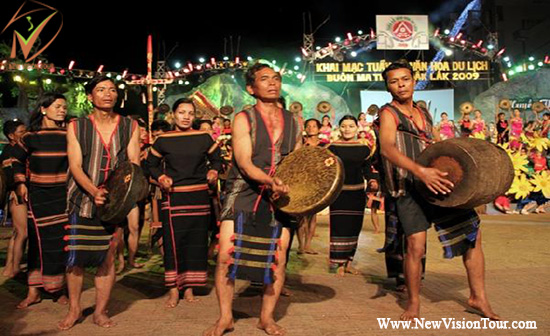
well-known khan (epics). Their musical instruments are comprised of gongs,
drums, flutes, pan pipes and string instruments. The Ding Nam is a very popular
musical instrument of the E De which is much liked by many people.
Costumes
Women wear a skirt and vest with
colorful motifs. Men simply wear loincloths. The E De likes to wear copper,
silver, and beaded ornaments.
Economy
The E De practice slash-and-burn
agriculture and cultivate rice in submerged fields. Besides cultivating, the E
De also practices animal husbandry, hunting, gathering, fishing, basketry, and
weaving.
