



Open House – Nha Rong
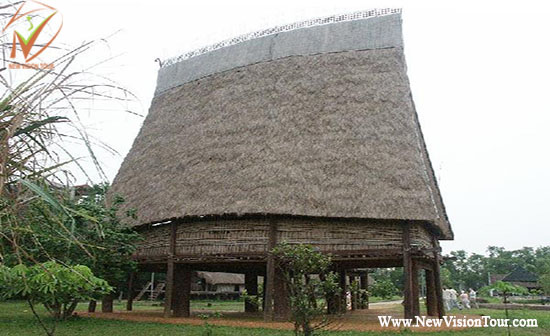
Opened in June of this year, the Bahnar communal
house tells a story of international co-operation to rescue a traditional
feature of Vietnam's Central Highlands from oblivion. Only painstaking
ethnographic research based on old photographs and folk memory, coupled with
joint funding from the museum and the German government, made reconstruction in
the traditional style possible.
The sharply angled building stands a breathtaking 17
meters high, making it an attention-grabbing centerpiece for the museum's
outdoor collection of ethnic minority houses. Built by a team of 29 artisans
under the expert guidance of museum ethnologists, it is a unique testimony to
traditional Bahnar building styles, all but wiped out by the tribulations of
history and a modernising drive. Today's Bahnar communities are likely to have
a communal house of cement and corrugated iron in the village centre, if at
all.
The reason for the house's extraordinary shape
remains unclear, adding an aura of mystery to the surprising structure. Perhaps
the ritual poles in the foreground, planted to form a bridge between the
earthly and the spiritual worlds, hold a clue to the house's symbolic meaning.
It is certainly awe-inspiring, as befits the traditional power centre of Bahnar
communities.
At the same time, the house represents a haven for
the Bahnar boys who live in it before their marriage to acquire the knowledge
and skills required for their adult life. Village elders teach the arts of
hunting, basket-weaving and music. They pass down the moral code, the history
and folklore of their forefathers. The communal house truly constitutes a
centre of village activity, where guests enjoy Bahnar hospitality, important
decisions are taken and religious rituals conducted. Although usually a male
preserve during and after construction, women traditionally had the job of
gathering thatch for the roof. All share in the ritual feasts held inside the
house.
