




The Pull of Natural Forces (Keo co)
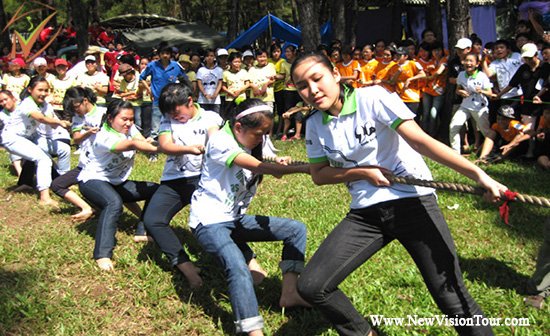
However, the moment a competition begins, the
viewers' noisy acclaim inspires the participants, increasing their zest to win.
Players divide into two teams and stand face to face
along a bamboo cord. A red piece of cloth marks the middle of the cord, which
is above a line drawn with lime in the dirt. After a signal from the referee,
players tug the cord as hard as possible to pull the red cloth towards their
side. Eventually one team loses strength and let go of the cord; the audience
cheers the other team as winners.
Tug of war has become a sport, but in many regions
it still reflects traditional Vietnamese beliefs. For example, in Tich Son
Village, Vinh Phuc Province, tug of war for men only is held on the third day
of the first lunar month after Tet. Organizers arrange the cord in an east-west
direction, evoking the trajectory of the sun. Older men stand to the east,
younger men to the west. After three matches, the team that compels the other
group to take three steps forward is the winner. According to traditional
belief, if the eastern (older) team wins, the villagers will have bumper crops
throughout the year.
Therefore, the western team often
"volunteers" to lose. Spectators cheer their favorite team from
outside a circle drawn with lime. They toss into the air and pass around over
their shoulders any villager-old or young-who steps over the line, whether
inadvertently or from pushing.
In Huu Chap Village, Bac Ninh Province, the tug of
war takes place on the fourth day of Tet. Players create two teams of unmarried
boys and girls. The boys represent the duong force (yang) and the dry
season, while the girls represent am (yin) and the rainy season.
Although the boys are frequently stronger than the girls, the girls often
"win" the tug of war so that the rainy season can outdo the dry season
and the harvests that year will be plentiful. The ritual meaning of the tug of
war is even clearer among the Thai ethnic minority.
Not long ago, Thai people in Con Cuong District,
Nghe An Province still performed a ritual called "pulling the dragon's tail"
as part of a prayer for rain. Thai people believe that drought occurs because
the dragon has overslept or is trapped underground. Thus, they must extract the
dragon by pulling its tail.
To this end, villagers bury rice plants and an areca
branch, which represents the dragon's tail, in a 50-deep hole. Then they place
a hollow section of the areca branch over a neighboring hole to serve as a
drum. Since the dragon is a female, the person officiating is a woman and
should be a widow as the bearer of the rice plant's soul. The moment
surrounding villagers beat the drum, which symbolises thunder, the woman tugs
on an areca leaf to make the rice grow. One after another, young girls come to
help her, forming a long row. Finally, they liberate the areca branch from the
earth for an omen of good harvest.
