




The Art of Traditional Wrestling
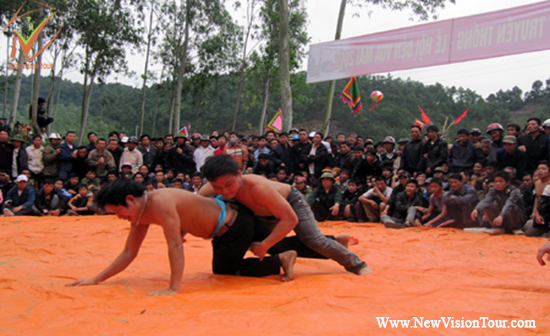
Were it not for the dry rhythm of the drum and the
overheated ambiance appropriate for sporting events, the surroundings might be
a set for an artistic performance, insofar as Vietnamese traditional wrestling
(vat) resembles dancing. Indeed, the most impressive aspects of this extremely
popular sport are its picturesque and well-choreographed qualities.
Wrestlers waiting for the fights to begin sit around
a "carpet." There is no ring or rope. Using lime, villagers have
drawn a square of around 10m on each side. The audience sits around the square,
watching with anticipation as wrestlers rub their sweaty hands on the earth,
all the while watching their opponents out of the comers of their eyes.
"Toong!
Toong! Toong!" The drum calls two competitors to the
fight. Like all traditional Vietnamese sports, a drum, a gong or sometimes both
accompany wrestling. The drum adds rhythm and stimulates the athletes. A
speaker announces the competitors, who stand up and step forward to the middle
of the "carpet." They are barebacked and wear red shorts with a silk belt
around their waist, red for one contestant and yellow for the other.
They dance with light footsteps recalling those of
birds. Their arms make supple and undulating movements, displaying their
musculature.
Then go the warm-up stage, a spectacle full of
panache and rich in color. Normally, this lasts two minutes while the drums
continue beating. Although the performances vary according to schools of
martial arts, ail warm-up dances must match the drum's rhythm. Once the
wrestlers have finished their warm-up, the principal referee introduces the
wrestlers by raising their arms as in boxing. Then the wrestlers turn away,
facing opposite sides of the arena. The drum resumes with well-spaced rolls.
The two adversaries turn, face to face, and shake hands. Then, with hands on
their hips, they stare at each in defiance. As the drum gives a dry beat, they
turn and step away from each other. They take further steps as the drum
continues, this time at a greater and greater speed. With this, the
"artistic" part of the match ends. There are no gifts once the fight
officially begins. The wrestlers turn around. They bend their backs and,
lowering their knees until they almost crouch, extend their arms. Eyeing one
another, they advance toward each other as if gliding, preserving their
equilibrium for the first strike.
The beating of the drum regulates the fight. The
rhythm accelerates as soon as one of the adversaries initiates a hold. It
returns to normal once danger has passed, as if the drum wants to let the
wrestlers recover their breath and preserve their guard. When a wrestler falls,
the rhythm accelerates, becoming more and more pressing. A finishing stroke of
the drum puts an end to the combat when the loser's shoulders touch the ground.
The winner and loser stand up, applauded by a prolonged drum roll.
Each wrestler has his own holds, passed down by his
coach, who is the only person who knows these secrets. The winner is the
wrestler who turns his adversary with his "face to the sky" and
forces his shoulders to touch the earth. Under modem regulations, a match is
composed of three four-minute rounds. But traditional matches often lasted for
hours, since the rules did not allow a draw.
