



Banh it
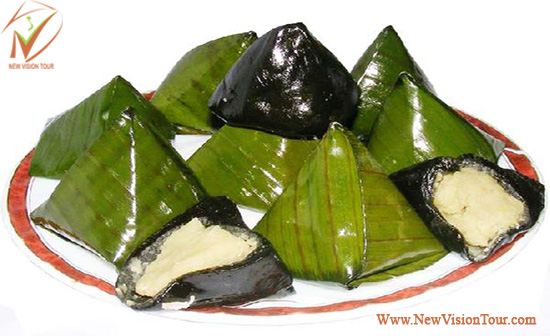
It shows how essential banh it la gai (sticky rice
cake) is to the people in the central region. Originating in Binh Dinh Province
on the central coast, banh it la gai has become a veritable specialty of that
region of Vietnam.
Banh it la gai is made from five ingredients -
sticky rice, la gai (a type of thorn leaf popular in the central region),
sugar, green beans (or black beans) and a banana leaf.
The la gai is boiled and then ground in a stone
mortar until its green colour turns black. The sticky rice is ground into
flour. The sugar is dissolved in water and then boiled down to make syrup. Then
the three ingredients are mixed together to make the dough. Meanwhile, the
green beans are soaked in water for hours and then whipped before steaming.
After that the well-done beans are ground and rolled into balls used as
fillings for the dough.
The dumpling can also be made with sweetened ground
coconut instead of beans. Either way the banana leaves are usually put quickly
on the fire or dipped in hot water to make them soft so that it is easier to
wrap the cake with them. The little packages usually are shaped like pyramids
with square bottoms. Then people arrange the packets into a pot for steaming.
Visiting Binh Dinh, tourists can discover how banh
it often stands right in the centre of locals' lives.
In death anniversaries, it is acceptable for there
to be no fish or meat, but there must be banh it la gai. In marriage rituals, a
tray of banh it la gai is the gift of the bride’s family to that of the groom
to show the skillfulness of the bride who has made the banh it together with
other villagers.
In the former imperial capital of Hue in Thua
Thien-Hue Province, tourists can also find banh it la gai and another type of
banh it called banh it ram.
Banh it ram is a little ball of sticky rice flour
stuffed with shrimp and pork so that the dumpling is also called banh it nhan
tom thit. The tasty morsel is served plain or wrapped in banana leaves and is
one of the indispensable dishes in the death anniversaries of a Hue family.
Banh it is also popular in the historic town of Hoi
An in Quang Nam Province. There tourists can find banh it not only at family
parties, wedding ceremonies and death anniversaries but also at restaurants.
Hoi An has two types of banh it: one with green bean
filling and wrapped in banana leaves called banh it la gai nhan dau xanh and
the other also filled with green beans but served plain called banh it la gai
tran. Unlike common banh it la gai, banh it tran usually is pink and smells
like la dua (a type of leaf that smells when it is steamed).
A famous banh it la gai-making family lives on Nhi
Trung Street in Hoi An. Stopping by their ancient house, tourists can learn all
the stages of making banh it. They can see how people prepare la gai, whip
beans, grind sticky rice and form the dumplings. Above all, they can enjoy banh
it right after it is steamed.
