



Fork paintings
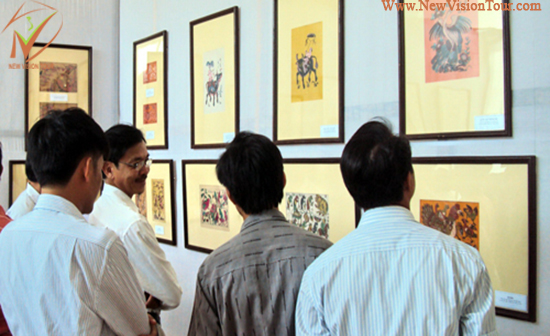
The Vietnamese believe in ancestor worship and the
deification of natural phenomena, both of which are reflected in the paintings.
Due to their historical popularity, the folk
paintings were produced in large quantities. This high demand was met through
the use of the woodblock carving printing technique, which has been practiced
by the Vietnamese for many centuries. During the Ly Dynasty (12th century),
there were many families who specialised in woodblock carving. By the end of
the Tran Dynasty, they were also printing paper money. At the beginning of the
Le So Dynasty, the Chinese technique of carving printing boards was adopted and
improved. The History Museum and the Fine Art Museum in Hanoi still keep old
printing boards as archives.
During the Mac Dynasty (16th century), folk
paintings developed quite extensively and were popular among the aristocracy in
Thang Long. In the 18th and 19th centuries, the art of folk painting was stable
and highly developed.
Depending on artistic style, drawing-printing
technique, and the materials used, folk paintings are classified into painting
trends according to the name of their place of production.
Each style of painting is different. However, in all
the styles, shapes are created based on the concept of don tuyen binh do
(single line-simple designs), which uses lines to bend the coloured shapes and
to make a border for the picture. Another method used is thuan tay hay mat
(easy to draw and to see). With this design form, the folk paintings do not
depend on the rules of perspective. The deities are large and take the upper
positions, while the ordinary people are drawn on a smaller scale and the size
of the animals and the natural scenery depicted depends on their relationship
to the sentiment or story being expressed. These unique characteristics make
the paintings profoundly impressive.
As a result of cultural exchange, Vietnamese folk
paintings have retained and developed certain traditional aspects. As well, the
paintings have been influenced and enriched by the genius of other painting
styles. One exception is Dong Ho paintings, which continue to exist unchanged
against the challenges of time.
Dong Ho Paintings
These paintings which originated in the Red River
Delta are the most famous. The artists coat do paper (the Rhamnoneuron paper)
with diep powder (a white powder made from the shells of diep, a kind of
fluvial bivalve mollusk) to make silver lustre glitter. Sometimes yellow flower
powder called Hoa hoe or orange-red sapandwood powder is used to make the
colors more elegant and shiny.
On that background, the colors are applied with a
woodblock. Some of the paintings only have simple black lines, while others are
printed with one other color. All of the materials for creating the colors for
these paintings come from nature. A wide spectrum of colors can be made using
mixing and multi-colored printing techniques.
Dong Ho paintings reflect people’s innermost
feelings, wishes, and simple dreams. Because the paintings appeal to so many
people, they are available throughout the country, from the village markets to
the capital city.
Hang Trong Paintings
Hang Trong paintings are also printed with black
lines to form the basis for the color. But, unlike Dong Ho paintings, they are
made by hand. Large sheets of imported paper and brightly colored paints are
used for Hang Trong paintings. The content of these paintings are very much
influenced by Chinese drawings.
Hang Trong paintings are popular as worshipping
paintings in temples. As such, the paintings are often hung in spacious living
rooms or in holy places.
Hang Trong paintings have traditionally served the
poorer classes and are made and sold in the capital city.
Kim Hoang Paintings
Kim Hoang paintings, which are often called red
paintings, are made on the outskirts of ancient Thang Long. Kim Hoang paintings
are printed and drawn on imported colored paper (yellow, bright red, pink) and
printed with black lines and shapes; other colors used to separate the shapes.
The colors are applied in rough, but flexible lines.
Sometimes, the paintings are reprinted to create clear line. The colors used
for Kim Hoang paintings are bought and then mixed by the painters, except for
indigo, which is self-processed. The themes of Kim Hoang paintings are similar
to those of the Dong Ho paintings, but there are also Chinese character
paintings Phuc, Loc, Tho (meaning “Happiness”, “Good Luck”, and “Longevity”
respectively), that have the typical flower of each season printed next to each
character.
Sinh Village Paintings
Sinh Village Paintings, which come from Sinh
Village, a suburb of Hue City, are well-known in the central region of Vietnam.
Most Sinh Village paintings are used for worship, and they express the
mystical, nature-based beliefs of the ancient Vietnamese.
Among these pictures is the Tuong Ba (Statue of the
Lady) painting, the guardian angel of women. Sinh paintings are made using just
one printing-board to create the drawing lines and black shapes. After being
printed in black, the work is sometimes completed with embellishments made with
colorful lines. Some paintings are still printed on rustic paper.
