



Things to do in Hoi An
The
Tung Chai or Coracles of Hoi An
In the villages around Hoi An, everyone learns to
row a Thuyen Thung almost before they learn to walk. The trick is to row these
basket boats without spinning round in circles. This is easy said than done
when you only have a single oar. These are coracles, traditionally made in the
same way. Basket weavers weave the skins, stretched out over wooden, slatted
frameworks before being covered in chai, a broad leafed plant material. They
become known as Thung Chai. The tarring has to be repeated every six months, to
maintain their water proofing.
After use, the small, round bamboo boats are
upturned and left to dry in the sun. They dot the sandy beaches everywhere. You
can find the story of their history in many documents and books. Centuries ago
groups of people from across the country moved to settle down in this area and
make a living by catching fish, oysters and shrimp when the French colonial
rulers levied taxes on many things including boats. The poor village people
could not afford to pay the tax, so invented a new type of vessel and gave it
the name thung chai, claiming they were not boats.
They are now a familiar sight in many fishing
villages on the central coast. Some of these crafty are decades old, and with
care outlive their owners. Virtually every single household in this area will
own one. In parts of these coastal waterways they villages will wait for the
large commercial boats to pass the bays, then row out in their little baskets
to purchase fresh food and vegetables on the sea.
Men and women both manufacture the coracles and sail
them. In some of the floating villages, children can sail these and swim,
before they learn to walk. They are a common sight everywhere as people of all
ages skillfully manoeuvre their boats to where they want to be.
It is quite remarkable how similar these boats are
to the famous coracles of Wales. Developed completely independent of each other,
thousands of miles apart, Families of two parents and three children can safely
be carried across waterways in these craft. Eco tours now offer trips in these,
where the tourists can have a go at sailing them. It is quite a difficult
technique to master and most people spend a while going round in circles until
they get the hang of it.
Walking
around Hoi An Ancient Town
When UNESCO inscribed the Hoi An Ancient Town onto
its list of World Heritage Sites, it said of this fascinating place, “Hoi An,
an exceptionally well-preserved example of a traditional Asian trading port, is
an outstanding material manifestation of the fusion of cultures over time in an
international maritime commercial centre”, a perfect description of a perfectly
unique city.
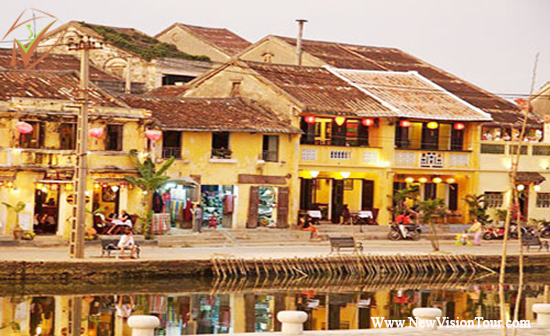
Hoi An Ancient Town is like a time capsule. Between
the 16th and 18th centuries it had the deepest sea port in all of Southeast
Asia and its location as a trading hub, right in the middle of the old spice
route, saw the town flourish. Great wealth was made and this was of course
reflected in the buildings. This growth continued through the 18th century but
at this time Da Nang was also developing and gaining ground on its neighbor.
Continued silting of the port at Hoi An, caused difficulties and the ultimate
demise of the town as a deep sea port. The town effectively ‘died’. As it
stagnated it was abandoned and lack of severe weather has seen the buildings
perfectly preserved, frozen in time.
Spending time walk around this living breathing
museum is a truly splendid way of occupying oneself. The buildings are
delightful. You will need to buy a ticket for admission, this contains
individual vouchers for all the significant buildings.
The quaint old shop houses are delightful, and the
religious monuments and pagodas are both culturally and scientifically
important. There is even the old ferry quay, long since unused, but interesting
to say the least. The old family cult houses were used for the worship of
ancestors, whereas the community houses were given over for the worship of
important long dead local figures. Sages, the founders of the town or those of
ancient crafts and skills, were held in very high regard.
Most of the pagodas were built in the 19th century,
though inscriptions tell that they were built on the sites of previous ones
dating from two hundred years before. One pagoda sits on a Japanese style
wooden bridge. This dates from the early 18th century and has been
reconstructed several times over the years. Tombs have been built within the
buffer zone. These are Vietnamese, Chinese and Japanese.
Walking around the Old Town is an unmissable
opportunity to discover one of the world’s great riches. It is a perfect
balance of history, art and culture, and a real jewel in the crown of Vietnam.
