The closet international airport is Noi Bai Airport which is located 40 km from Hanoi. There is a highway from the airport into the city, making it easily accessible.
Getting there
The closet international airport is Noi
Bai Airport
which is located 40 km from Hanoi.
There is a highway from the airport into the city, making it easily accessible.
It is possible to travel by taxi from the airport to Hanoi. Use a metered taxi or bargain for a
fare before starting your journey. Beware of taxis with meters that are rigged
to charge a higher price. Shuttle buses from the airport are another option.
Many trains depart from Hanoi to other areas of Vietnam. Within
the city taxis, motorbike taxis, buses and bicycles are popular means of
transport. Traffic in the city is intense and visitors should exercise caution while
traveling around the city.
Getting around the city
There are three main modes of public transportation:
- Taxis now abound in Hanoi.
They are metered, inexpensive, and reasonably safe. Most drivers are quite
honest; a few would rather bargain for the price of a ride (and keep the fare
themselves) than turn on the meter. Taxi drivers frequently do not have small
change and often hope that foreign passengers will simply forego getting change
for their big bills. Carry small change or stay in the taxi until the driver
procures change.
- Xe om (seh ohm), or motorcycle taxis, are even more
abundant than taxis. They can be identified by the green pith helmets their
drivers almost invariably wear. Riders must bargain with drivers for the price
of the ride before getting on the back of the bike. Xe om drivers often drive
carelessly and frequently spend their time between fares drinking at local beer
stands. Riders are not provided with helmets and are in the traffic segment
most vulnerable to accidents.
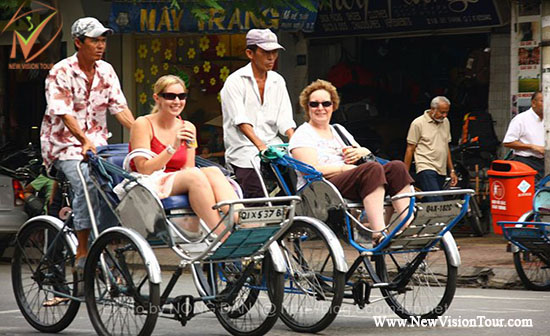
- Cyclos (seek-loh), bicycle-powered taxis, are used on the
streets of Hanoi
for everything from carrying passengers to moving entire contents of houses.
The front "cab" of a cyclo is designed for two passengers but it is
not unusual to see a driver straining to pedal a cab loaded down with four or
five. Cyclo fares must also be negotiated up front. Cyclos are the slowest and
least maneuverable vehicles on Hanoi
streets, although they tend to stay along the edges of traffic and are not as
vulnerable to higher-speed accidents.